
Sports Injury

Sports Injury Clinic in Lisburn, Northern Ireland

At a Glance

Sports Injury Clinic in Lisburn

Sidelined by a sports injury? Gav Noble Physiotherapy is a chartered sports injury clinic in Lisburn, treating runners, golfers, GAA and rugby players from across Northern Ireland since 2015. We diagnose the root cause, not just the symptoms, and build a return-to-sport plan that gets you back to full performance. No GP referral needed, and most new patients are seen within 48 hours.

  • What is it? Diagnosis, treatment and return-to-sport rehab for injuries from sport and exercise.
  • Who is it for? Runners, golfers, GAA and rugby players, and gym and club athletes.
  • How long? A 45-minute first assessment, with most injuries resolving in 4 to 8 sessions.
  • Referral needed? No GP referral. Most new patients are seen within 48 hours.

Sports physiotherapy to get you back to training, fast

Key Takeaways

A sports injury clinic diagnoses, treats and rehabilitates injuries from sport, then tests you before you return.

Treatment is led by chartered physiotherapists (HCPC and CSP) and qualified sports therapists.

Most injuries resolve in 4 to 8 sessions; tendon injuries take 6 to 12 weeks of progressive loading.

No GP referral is needed, and most new patients are seen within 48 hours.

What sports injury treatment involves

A sports injury clinic diagnoses, treats and rehabilitates injuries caused by sport and exercise, then builds a structured plan to return you to full performance. Sports injury treatment in Lisburn is led here by chartered physiotherapists (HCPC and CSP) and qualified sports therapists at Gav Noble Physiotherapy. We begin by watching how you actually move, because a sore knee often traces back to a stiff hip, and a nagging Achilles to how you load each stride.

The assessment is where the real answers come from. We take a full history of your sport and training load, run specific clinical and special tests, and use biomechanical assessment and slow-motion video gait analysis to find the root cause rather than the sore spot. From there, treatment combines hands-on care with progressive rehabilitation: manual therapy, joint mobilisation, soft tissue and myofascial release, dry needling, and taping to settle symptoms, always paired with eccentric loading and progressive resistance exercise to rebuild the tissue.

We cover every region an athlete injures: knee and lower limb, foot and ankle, hip and groin, shoulder, elbow and wrist, and the spine. Whether it is a running injury, tennis elbow, a golf injury or an acute tear, the goal stays the same. We get you back to your sport safely, then keep you there with return-to-sport testing before you go back.

Who it helps and what to expect

This service is built for active people who want a real answer, not just rest advice. As a running injury clinic in Lisburn, we see runners with knee, shin, Achilles or IT-band pain most weeks, alongside golfers, tennis and racquet-sport players, rugby, hockey and GAA players, footballers, cyclists, gym-goers, weightlifters and CrossFit athletes. It also suits teenage and youth athletes, over-45 active adults protecting hard-won fitness, and anyone returning from an injury who wants to come back without re-injuring.

Book if pain has not settled on its own, if you felt or heard a "pop" and need an urgent assessment, or if a niggle keeps interrupting training. Book too if another clinic simply told you to rest, with no diagnosis and no plan to get you back. You start with a free 15-minute discovery visit, then a full 45-minute assessment and a written plan. From there it is hands-on treatment paired with rehab you are taught and filmed in the clinic, progressive strengthening as symptoms settle, and a return-to-sport test before discharge. You leave with a written home exercise and injury-prevention programme, and the same team is here if a niggle returns.

Techniques and equipment we use

The tools behind the work are practical, not gimmicks. We use a shockwave therapy machine for stubborn tendon injuries like Achilles tendinopathy and tennis elbow, fine needles for dry needling, and a video gait-analysis camera to read your running mechanics. For loading and testing we use resistance bands and a strength-testing dynamometer, with an ultrasound therapy unit where appropriate. To support a return to training we apply kinesiology tape such as Rocktape and rigid sports strapping, and fit braces, supports or custom foot orthotics where the injury calls for it. Cold-therapy compression and a filmed home exercise programme round out your self-management.
Why Us

What makes our sports injury care different

Book an Appointment — opens in a new tab

Worked with elite rugby, hockey and netball athletes. the same standard of care applied to every patient.

Structured return-to-sport protocols. we test and clear you to play, we do not just say "rest it".

Gait and biomechanical analysis. we find the root cause of overuse injuries, not only the sore spot.

Back to training fast. active rehab and progressive loading, no prolonged rest.

Card 1 note: if specific clubs can be named with permission, name them. If not, this wording is the safe, backable version.

Your Treatment

How your treatment works

Pricing

Pricing tailored to your treatment plan

We talk pricing through at your free discovery visit, before you commit to anything, and you get a written session estimate once we know what the injury actually needs. Athletes are usually looking at a defined block of sessions rather than an open-ended course. If you hold private cover, treatment may be fully paid for and we bill your insurer directly.

Sports Injury

Why Lisburn athletes choose our sports physio

  • 01Training around work, and injuries that turn chronic

    Most local athletes train around a full-time job and the Belfast commute, so they push through niggles they have no time to rest. A small overuse injury then quietly turns chronic, which is when a sports physio in Lisburn usually gets the call.

    We see it constantly: weekend GAA and rugby knocks, runners logging miles on the Lagan towpath, cyclists loading the hilly roads around the Lagan Valley, and gym and CrossFit strains right across the catchment.

    The terrain plays its part. The forest trails, towpaths and hilly roads that make this a great place to run and ride also load the knees, shins and Achilles hard, which is why runner's knee, shin splints and Achilles tendinopathy are among the injuries we treat most. Cold, wet Northern Irish winters add a seasonal spike, pushing training onto hard, slippery ground and indoors, and bringing calf strains and slips with them.

    Then there is the wait. NHS physiotherapy lists across the Belfast and South Eastern Health and Social Care Trusts are long enough that the Department of Health runs a Waiting List Reimbursement Scheme, and for an athlete, every week on a list is lost fitness and a slower, riskier return.

  • 02Where we are and who we treat

    We are based at 66 Antrim Street — opens in a new tab in the centre of Lisburn, in County Antrim, with the catchment spilling across the River Lagan into County Down. Free parking sits outside the clinic, and Lisburn Railway Station on the Belfast to Dublin line is a five-minute walk away. We are about a mile from the M1 at junctions 3, 6, 7 and 8, minutes from the A1 at Sprucefield, and on the A3 Hillsborough Road for the west of the area.

    That makes us easy to reach from right across the Greater Belfast and Lagan Valley area. Lambeg is minutes up the A1,

    with Dunmurry, Maghaberry, Hillsborough and Drumbo all inside ten minutes. Athletes travel in from Moira and Aghalee

    off the M1, from Glenavy and Crumlin to the north-west, from Carryduff and Saintfield on the A49, and from Belfast,

    Dromore, Ballynahinch and Banbridge across the wider catchment.

    Plenty of the overuse injuries we see are earned close to home: on the Lagan towpath and in Lagan Valley Regional Park, on the loop at Wallace Park, and at the gyms, GAA, rugby and hockey clubs around the Lagan Valley LeisurePlex. Student athletes at South Eastern Regional College are a short walk away, and Sprucefield Retail Park is minutes from the door.

  • 03How we assess and treat sports injuries

    Our approach is built on named methods, not vague promises. Assessment combines biomechanical testing, movement screening and video gait analysis. Treatment draws on manual therapy, joint mobilisation, soft tissue and myofascial release, dry needling, and shockwave therapy for stubborn tendons, then eccentric loading and progressive resistance exercise to rebuild strength and control. We finish with return-to-sport testing, checking strength, control and sport- specific movement before you play.

    We treat the full range of conditions an athlete faces: runner's knee, IT band syndrome, shin splints, Achilles and patellar tendinopathy, calf, hamstring and groin strains, ankle sprains, tennis and golfer's elbow, rotator cuff and shoulder problems, plantar fasciitis and sports-related back pain. Every clinician is chartered (HCPC and CSP) or a qualified sports therapist, and "physiotherapist" is a legally protected title, so a serious injury like an ACL tear is properly assessed rather than missed. Treatment is recognised by Bupa, AXA, Aviva, Nuffield, WPA and Simplyhealth.

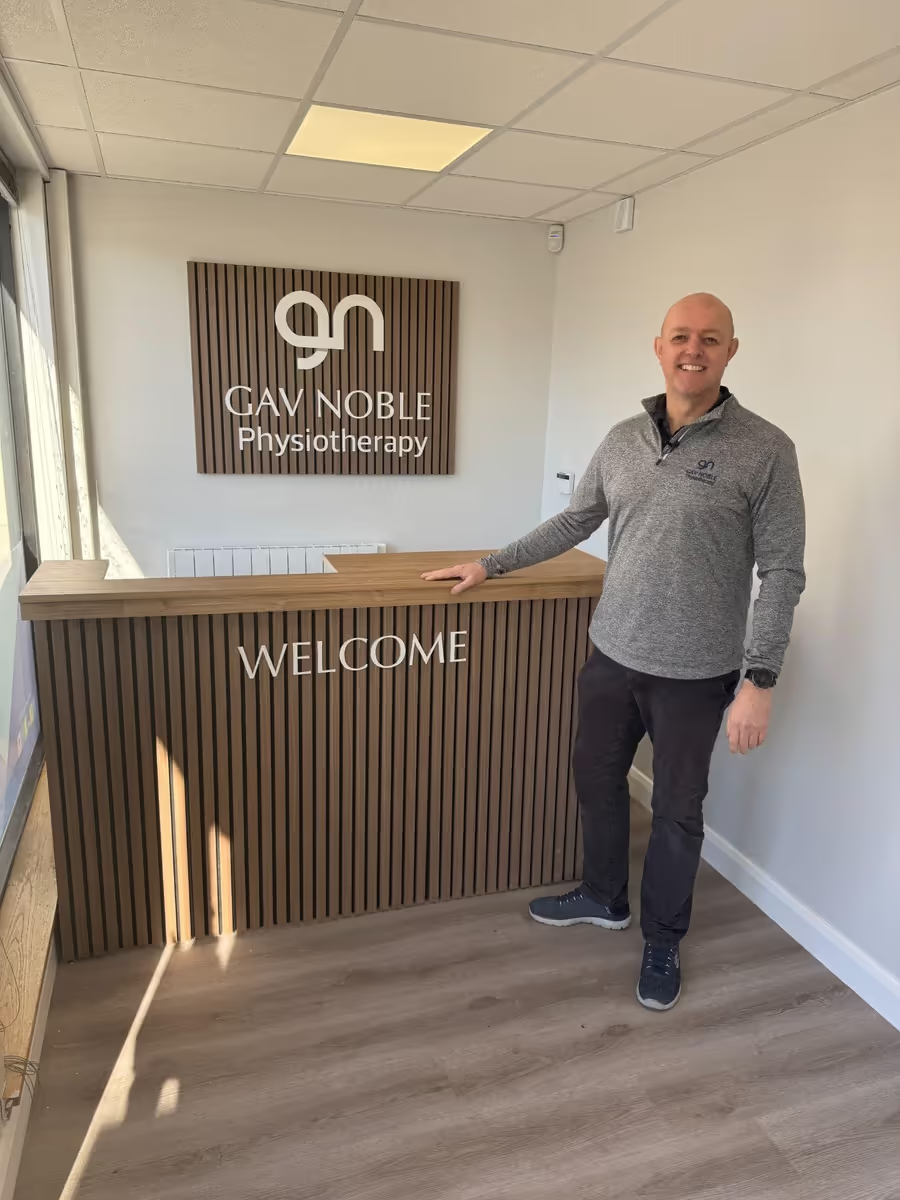
The reception area at Gav Noble Physiotherapy in Lisburn
Questions

What is a sports injury clinic and how does it work?

A sports injury clinic diagnoses, treats and rehabilitates injuries from sport and exercise, then guides a safe return to play.

Should I rest my sports injury or see a physio?

Rest and protect the injury for the first 24 to 48 hours. After that, as Gavin puts it, motion is lotion, rest is rust, the right early movement usually beats complete rest. If sharp pain, swelling, instability or stiffness lasts beyond three to five days, see a sports physiotherapist. Simply resting rarely fixes the cause, and pushing through turns a minor injury into a chronic one. Early assessment means a faster, safer recovery.

What's the difference between a sports therapist and a physiotherapist?

A physiotherapist is HCPC-registered and chartered, trained to diagnose and treat the full range of injuries and medical conditions. A sports therapist specialises in sport-related musculoskeletal injuries and rehabilitation. At Gav Noble Physiotherapy you get both under one roof, so serious injuries are properly assessed and every athlete gets sport- specific rehab.

Can I just treat a sports injury myself at home?

Basic first aid helps early on, rest, ice, compression and elevation for the first 48 hours. But self-treatment can't diagnose the root cause, and the wrong exercises can slow healing or cause re-injury. A missed serious injury, like an ACL tear or fracture, needs proper assessment. Home rehab works best guided by a physiotherapist.

How long does it take to recover from a sports injury?

It depends on the injury. Minor strains and sprains often settle in two to six weeks; tendon injuries like Achilles or tennis elbow take six to twelve weeks of progressive loading; ACL or post-surgery rehab can run three to twelve months. You get a realistic timeline in writing after your assessment.

What if physio can't fix my sports injury?

That is exactly what the free 15-minute discovery visit is for. You explain the injury and your sport, and we tell you honestly whether physiotherapy is the right answer, with no obligation and no payment. Some injuries need a scan or a surgical opinion first, and we will say so rather than start a course of treatment that will not work.

When can I return to sport after an injury?

You return to sport once you pass return-to-sport testing, not just when the pain stops. We check strength, control and sport-specific movement, hop and strength tests where relevant, so the injured area can handle the demands of your sport. Returning too early is a leading cause of re-injury, so we clear you properly.